
As the U.S. economy continues to navigate turbulent waters, a looming threat has reentered the financial lexicon: stagflation. With the first quarterly contraction in GDP since 2022, paired with rising consumer prices, investors are increasingly concerned that the country could be headed into a period of economic stagnation marked by inflation—a rare but deeply troubling combination.
The trigger? A complex web of geopolitical tension, renewed tariffs on U.S. trading partners under President Donald Trump’s administration, and persistent inflationary pressures. Together, they’ve created the kind of economic environment that’s difficult to unwind and nearly impossible for policymakers to manage cleanly.
Understanding Stagflation: A Double Bind for the Economy
Stagflation is defined by the coexistence of stagnant or contracting economic growth and rising inflation. In simple terms, it’s an economic trap where consumers are squeezed by higher prices while job creation stalls and business investment slows. It’s a worst-case scenario that challenges conventional monetary policy—because raising interest rates to fight inflation often slows the economy even more, while lowering rates to stimulate growth can worsen inflation.
And the signs are starting to flash red.
Data from the Commerce Department revealed that U.S. GDP fell by 0.3% in Q1 2025. At the same time, inflation expectations among consumers have been on the rise, according to recent surveys by the Federal Reserve. For many Americans, that means groceries cost more, energy bills are up, and wages aren’t keeping pace.
Tariffs: Fuel on the Inflation Fire
A key factor intensifying the current economic unease is the reimplementation of tariffs—taxes placed on imports—by the Trump administration as part of an effort to rebalance trade relationships. While the political calculus behind tariffs is hotly debated, the immediate economic impact is far clearer: higher costs for businesses and consumers alike.
Importers bear the initial burden of these taxes, but those costs often ripple downstream in the form of higher retail prices. From electronics to everyday household items, tariff-induced price hikes are adding to the inflation problem—and doing so in a way that monetary policy can’t easily correct.
Ellen Zentner, chief economic strategist at Morgan Stanley, put it bluntly: “Even if today’s weak GDP may have partially reflected companies trying to get ahead of tariffs, it was still a stagflation warning shot over the bow of the economy.”
The Fed’s Dilemma: Limited Tools, Growing Pressure
For the Federal Reserve, stagflation presents a no-win scenario. Its dual mandate—maximum employment and stable prices—becomes nearly impossible to achieve when the two goals work against each other. If the Fed raises interest rates to rein in inflation, it risks deepening the slowdown. If it holds steady or cuts rates to stimulate growth, it may fuel even more inflation.
David Bahnsen, managing partner and CIO at The Bahnsen Group, noted that this time, inflation isn’t being driven by excess money in the system, but by external policy decisions—namely tariffs. “There’s almost nothing the central bank can do about stagflation,” he said. “It’s totally outside the domain of the central bank.”
This leaves businesses, investors, and consumers in limbo, uncertain how long the tariffs will last or how severely they’ll impact long-term growth. Bahnsen believes a rollback is likely but warns that the longer uncertainty persists, the more businesses will hold off on hiring and investment—slowing the economy further.
What It Means for Savers and Retirees
Periods of stagflation can be especially damaging for retirees and those nearing retirement. As inflation erodes purchasing power and market volatility eats into savings, traditional portfolios can take a hit. Bonds lose value, equities become unpredictable, and cash loses value sitting idle.
That’s why many investors are revisiting precious metals—especially gold—as a strategic hedge.
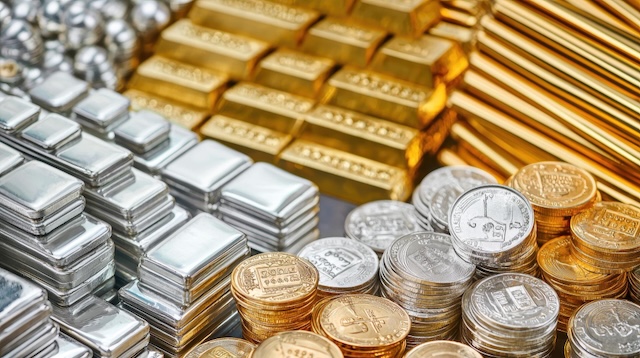
Gold historically performs well during periods of inflation and economic uncertainty. Unlike paper assets, gold is not dependent on interest rates or corporate earnings. It’s a real, tangible store of value that tends to maintain purchasing power even when currencies falter.
In the 1970s, during America’s last major bout with stagflation, gold prices soared from $35 per ounce in 1971 to over $600 by 1980. While no one can perfectly predict the future, today’s environment shares some familiar signals: high inflation, weak growth, and policy uncertainty.
Precious Metals: A Shield in Uncertain Times
For investors seeking stability, diversification, and a buffer against rising costs, gold and other precious metals offer a compelling case. Unlike stocks and bonds, which can be rocked by political decisions and economic shifts, gold operates on different fundamentals—scarcity, demand, and historical value.
With central banks around the world continuing to stockpile gold and institutional investors upping their allocations, the message is clear: when uncertainty grows, gold remains a pillar of security.
At GoldenCrest Metals, we help Americans protect their hard-earned savings from market volatility, inflation, and economic policy swings. Whether you’re looking to diversify your portfolio, hedge against inflation, or explore the benefits of a Gold IRA for your retirement strategy, our team is here to help.
Speak with a GoldenCrest Metals specialist today to learn how gold can play a role in preserving your financial future—especially during uncertain economic times.
Source:
https://www.foxbusiness.com/economy/economic-tumult-serious-concern-has-emerged-stagflation